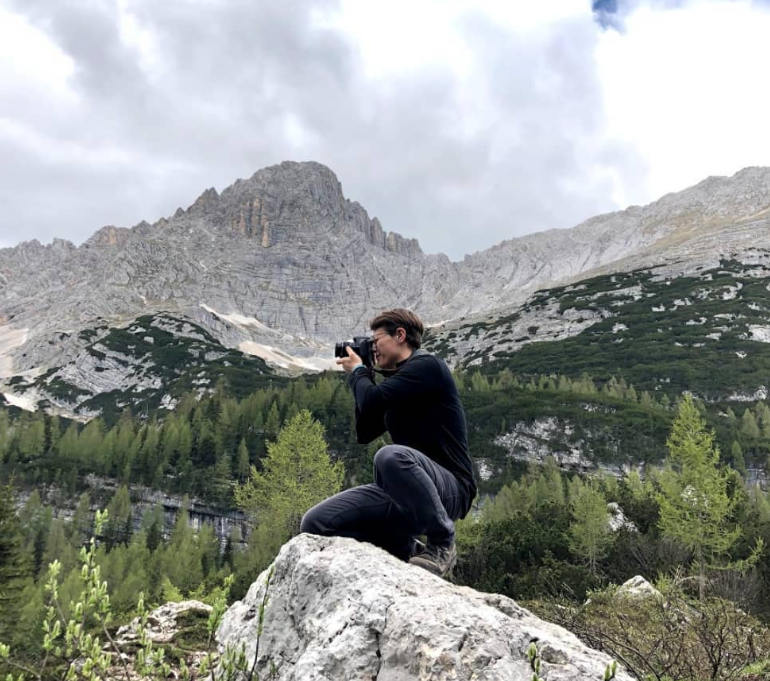
Kim Eitner Spotlight

You have either attended or worked in international programs for some time. What drew you to them and what made you want to keep pursuing that path?
I think what first drew me to international education was the realization that things are done differently in different parts of the world. That seems like such an obvious statement now, but as a 20-year-old from a town of about 400 people, I had very little exposure to diverse perspectives. Traveling abroad for the first time, and later studying abroad through CIMBA, genuinely expanded my worldview. I saw that different cultures prioritize different aspects of life, celebrate different things, and express shared values in very different ways. That experience showed me I didn’t need to force myself into the narrow cultural expectations of my hometown. If I didn’t feel like I belonged there, I could find belonging elsewhere.
That appreciation for diversity of thought is what has always stood out to me about the CIMBA MBA program. Our cohort included everyone from a 22-year-old American woman straight out of undergraduate studies to a mid-career Egyptian vice president at a large corporation, with countless experiences in between. Each classroom discussion brought dozens of perspectives to the table. By sharing, challenging, and combining those viewpoints, we were able to reach solutions that none of us could have arrived at alone.
That same dynamic is what has kept me working in international education. I love that I am constantly learning alongside my students. Whether I’m helping someone from Benin navigate setting up utilities in Oregon or reminding American students not to order a cappuccino after lunch in Italy, there is always just as much for me to learn as there is for me to teach. Cross-cultural work – along with travel for fun – pushes me out of my comfort zone and forces my brain into System 2 thinking, which helps me continually grow as an individual.
What value or teaching from your time at CIMBA do you carry into your current role?
This is a difficult question to answer because so much of what I learned at CIMBA, both inside and outside the classroom, has shaped who I am today. If I had to highlight one core takeaway, which is especially relevant right now, it would be this: human connection is irreplaceable.
Dr. Al has been talking about automation and “the robots taking our jobs” for decades, and now we are seeing it happen at a large scale. As AI continues to transform the workplace, technical and routine tasks are increasingly automated. What remains distinctly human are the skills that CIMBA emphasizes - leadership, communication, self-awareness, and emotional intelligence. These are not just “soft skills”, they are the capabilities that enable people to lead teams, navigate ambiguity, build trust, and make meaning out of complex situations.
I believe those are exactly the kinds of skills that will define careers that cannot be replaced by AI. Roles may change, tools will certainly evolve, but the ability to understand and influence people, collaborate across differences, and thoughtfully respond to new challenges will only become more valuable. In the class I teach now, which focuses on how individuals behave within organizations, I try to (whoops) my intention is to pass these ideas on to my students.
It’s funny – at the end of my tenure as a Campus Life Coordinator at CIMBA, I wrote a blog post about “My CIMBA Experience.” In that, I highlighted this takeaway: “It is the people in an organization that matter. People are irreplaceable.” And now that is literally the first lesson I teach in my class. People are inimitable, and employees are resources that can give any organization a competitive advantage.
What has your position as a Management Professor taught you in the last 6 months?
The past few months of teaching have reaffirmed something I first learned when I started working with students: they don’t read. Whether it’s a textbook, a research article, or even assignment instructions, if it takes longer than about 30 seconds to get through, I’m competing with a thousand other demands for their attention.
That reality has pushed me to rethink how I teach. Instead of relying heavily on traditional readings, I’ve had to focus on methods students actually engage with: hands-on, collaborative exercises that connect directly to real-world situations. But over time, I’ve realized this isn’t just about delivery methods or content.
What has stood out most is that students want many of the same things from a class that we all want from our jobs and managers. They want clarity, consistency, and fairness. They want to feel heard and respected. They don’t want to waste time on busywork - they want to understand the purpose behind what they’re doing and how it will benefit their future. They want to make an impact, and they want to see growth in themselves.
Because of that, the most meaningful feedback I’ve received hasn’t focused on specific topics or assignments. It has focused on the learning environment. When students feel engaged, supported, and challenged in the right ways, the content becomes more impactful.
That’s probably been the biggest lesson for me: effective teaching, much like effective leadership, isn’t just about what you deliver - it’s about the environment you create. And in many ways, that matters far more than whether or not they did the reading. It’s a lesson that reflects what CIMBA emphasized throughout my experience: leadership is less about directing outcomes and more about empowering others to grow and succeed.
Any advice for CIMBA students who are looking to explore a career in higher education?
As with any industry, there are pros and cons to working in higher education. Bureaucracy is a factor and funding is often difficult. On the plus side, you get to work with extremely intelligent people who are always looking to discover something new. And you can make a big impact on a lot of people – students and others. Higher education has a long history, and not all of it is sunshine and rainbows. But there is no future without it.
Beyond that, I’d give this career advice to any student: whatever you do next doesn’t have to be forever. While there are advantages to having a long career in one field, it’s okay to try different things, and you shouldn’t stay on a path that doesn’t feel right for you. I talk to my students about how job satisfaction is one of the biggest factors in life satisfaction, especially in the US. If you find that your dream job isn’t what you thought it would be, or if you’re just feeling a pull in a different direction, don’t be afraid to take a chance, step out of your comfort zone, and make a change.